
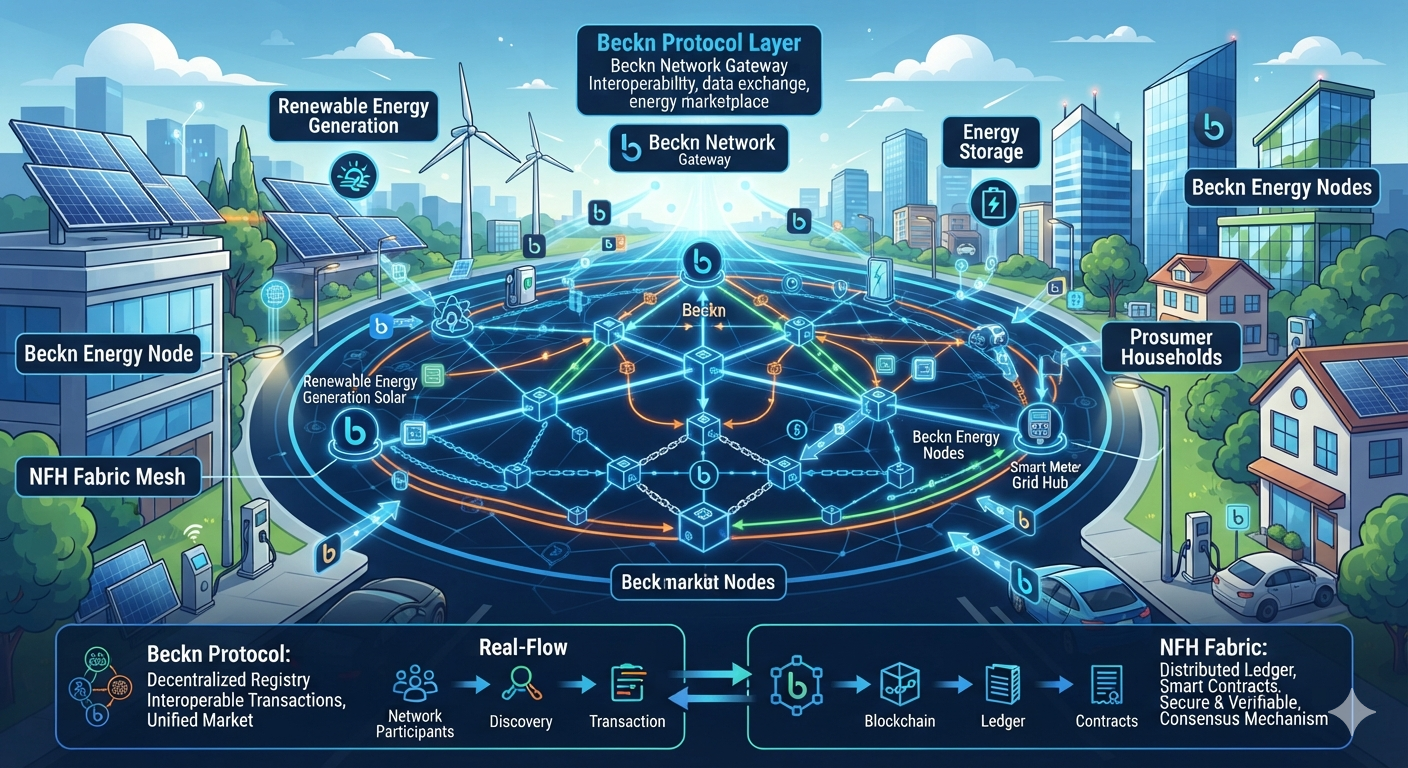
The energy grid doesn’t really have a discovery problem. Most rooftop solar owners, EV drivers, and battery owners already know roughly what they want. What’s missing is a common way for all of them to trust each other enough to transact. That’s the actual gap a decentralized energy network on Beckn is meant to close.
Think about what’s already sitting around, mostly idle. Solar panels producing more than a household needs. EVs parked for hours with a battery that could feed power back somewhere. Home batteries sitting at 40% capacity because there’s no easy way to sell that headroom to anyone. None of this is a hardware problem anymore. It’s a coordination problem, and coordination problems need a shared protocol before they need an app.
We’ve spent the last few months building on Beckn and the NFH Fabric ourselves, and the deeper we’ve gone, the more we think energy is where this whole design gets tested hardest. This post is us laying out why?
What a decentralized energy network on Beckn actually is
Strip away the buzzwords and it’s fairly simple: a decentralized Strip away the buzzwords and it’s fairly simple: a decentralized energy network on Beckn is a peer-to-peer market for energy-trading, EV charging, battery monetization, microgrid coordination that runs on an open protocol instead of living inside one company’s app.
The same group of people behind India’s population-scale digital infrastructure, including Aadhaar and UPI, built Beckn. The idea carries over almost directly. Instead of one platform owning the marketplace, Beckn standardizes the pieces: discovery, negotiation, contracting, fulfilment, post-fulfilment. Any buyer-side app and any provider-side app can transact directly. No central player takes a cut in the middle. No single company decides who gets to participate.
In energy, this shows up as two efforts already running inside the Beckn ecosystem:
- DEG (Digital Energy Grid) connects distributed clean-power assets so they can be discovered and traded like any other resource on the network
- UEI (Unified Energy Interface), sometimes called “Beckn for Energy,” is trying to do for EV charging what UPI did for payments- make finding and paying for a charge point as boring and reliable as sending money
And this isn’t a whitepaper concept. Beckn’s numbers across all its domains are already real: over 300 million digital commerce orders, more than 125 million zero-commission rides, and tens of megawatt-hours changing hands daily on open energy grids through DEG and UEI.
Where Beckn gets its trust from: the NFH Fabric
Beckn doesn’t work in isolation. It runs on top of the NFH Fabric, the shared infrastructure layer maintained by Networks for Humanity (NFH), a non-profit network of labs building open digital infrastructure at population scale. It’s backed by people like Nandan Nilekani and built by many of the same architects who worked on Aadhaar and UPI.
The Fabric itself is a handful of pieces: a public registry for participant identity, a credentialing layer, a transaction ledger, catalogue and discovery services, and the Beckn protocol sitting on top. Beckn is one of NFH’s two flagship missions, the other is Finternet, an open network for finance built on similar principles.
In the current version of the protocol, that registry is a DeDi-compliant trust directory. Every participant registers their identity, endpoints, and public keys there. Every signed message gets checked against it before anyone acts on it. That sounds like a small detail, but it’s actually the whole point. A solar prosumer, a charge point operator, a grid operator, and an aggregator have no reason to trust each other by default. The registry is what lets them trust each other’s messages instead – which is a much smaller, more solvable problem than trusting each other’s intentions.
Why energy is the hardest thing to build on Beckn
NFH itself puts this well: a lot of the world’s hardest coordination problems i.e energy reliability, healthcare access, sustainable mobility come down to countless independent actors who need to operate under shared trust with no obvious central coordinator. Energy fits that description almost perfectly, which is exactly why it’s a harder use case than commerce or ride-hailing.
A few reasons it’s genuinely tougher. Discovery and settlement often have to happen fast. A charge point needs to confirm it’s available before a driver commits to driving there. A grid-balancing signal can’t wait around the way a retail order can.
The failure modes are physical, not just financial. A broken transaction in retail is an annoying refund. A broken transaction in energy can mean a stranded EV or a grid that doesn’t balance.
The participants don’t speak the same language operationally either. A utility, an aggregator, and an individual prosumer all think about “a unit of energy” differently. That alone makes catalog design harder than it looks.
And trust can’t be assumed, it has to be provable. Every signed request needs to resolve against the right public key in the registry. Get that wrong and the network doesn’t fail gracefully, it just rejects the request.
What this looks like when it breaks
That last part is easy to underestimate until you’ve actually run into it. A network can look completely healthy from the outside. Every service is running, the gateway is reachable, the registry is up. And it can still return a flat rejection on something as simple as a search request, with no error message and no hint of why.
The usual cause is a signing key on one side not matching the public key sitting in the registry on the other. It’s a general Beckn problem, not an energy-specific one. But energy networks have far more participants and much less tolerance for silent errors, so that kind of failure gets more dangerous there, not less.
What building on the NFH Fabric actually takes
Most writing about decentralized energy networks stays up at the protocol level – discovery, negotiation, settlement, all described in the abstract. What actually determines whether a network works, even outside of energy, is the gap between “the protocol allows this” and “this is safe to run in production.”
Getting any Beckn network running means a handful of things all have to line up at once. The infrastructure – registry, catalog service, discovery service, protocol adapters has to be deployed consistently, whatever the cloud provider or topology. Identity has to be airtight: every participant’s signing key has to match its registry record, with zero drift between config files, payloads, and adapter identity. The application layer needs real business logic behind it, not a copy-pasted template. Actual catalogs, actual connectivity plans, actual payloads for the actual use case and the whole thing needs guardrails that refuse to let a deployment go live with an unverified key or a plaintext secret sitting somewhere it shouldn’t be.
None of that is specific to energy. But energy is where getting it wrong costs the most, and where getting it right unlocks the most.
Where AI agents come in
Once the infrastructure and application layers actually hold up, a more interesting question shows up: what happens when AI agents, not just human-operated apps, start acting as participants on a decentralized energy network?
Beckn’s design doesn’t treat autonomous and non-autonomous participants that differently. Openness, verifiability, and composability apply either way. NFH’s own docs talk about building with agents as a normal path on the fabric, not a hypothetical one.
For energy, that opens up some genuinely useful possibilities:
- An agent that negotiates a trade between a prosumer’s surplus solar and a neighbor’s load, within rules the prosumer set ahead of time
- An agent that finds the best available charge point on a UEI-connected network, weighing price against wait time against how far out of the way it is
- An agent watching a grid signal and shifting a battery’s discharge automatically instead of waiting for someone to notice and act
- Multi-party settlement across aggregators, grid operators, and individual participants, verified cryptographically at every step against the registry
None of that works, though, without the trust and identity discipline underneath it. An agent negotiating on someone’s behalf is only as safe as the network’s ability to verify who it’s actually talking to. That’s not a reason to slow down on the agent side, it’s the reason the infrastructure work has to come first, not after.
Why we’re paying attention to this
We’ve been building on Beckn and the NFH Fabric for a few weeks now. Mostly on general-purpose infrastructure and application tooling rather than an energy deployment specifically. That work has taught us most of what’s above the hard way: the registry and identity mechanics, the gap between “the containers are running” and “the trust path actually works,” and how much discipline it takes before you’d trust an agent to act on its own on a live network.
Energy is the use case that keeps pulling our attention, for exactly the reasons laid out here – it’s where the fabric’s trust model matters most, and where the payoff for getting it right is largest. If you want the more hands-on version of what that infrastructure and identity work actually looks like, we’ve written about it directly here and here.
Frequently Asked Questions
What is a decentralized energy network on Beckn? It’s a peer-to-peer energy marketplace – covering trading, EV charging, and battery monetization. It is built on the open Beckn protocol instead of a centralized platform, letting any consumer-side and provider-side application transact directly through shared, interoperable standards.
What is the NFH Fabric? The NFH Fabric is the shared open infrastructure layer maintained by Networks for Humanity (NFH). It includes a public registry, credentialing, a transaction ledger, catalogue and discovery services, and the Beckn protocol together forming the trust foundation that networks like Beckn’s energy initiatives run on.
What are DEG and UEI? DEG (Digital Energy Grid) and UEI (Unified Energy Interface) are Beckn-based energy initiatives. DEG connects distributed clean-power assets for discovery and trading. UEI, often called “Beckn for Energy,” unifies fragmented EV charging networks into one interoperable discovery and payment layer.
Why is energy considered a hard use case for Beckn? Energy transactions involve tighter real-time constraints, physical consequences when something fails, and a much more heterogeneous set of participants- prosumers, utilities, aggregators, charge point operators than a typical retail or commerce network, which raises the bar for trust verification and reliability.
Can AI agents operate on a decentralized energy network? In principle, yes. Beckn’s design doesn’t distinguish sharply between autonomous and human-operated participants, so agents can be built to discover, negotiate, and settle energy transactions – as long as they operate under the same cryptographic trust guarantees as any other participant.
References
- NFH Fabric overview and Beckn protocol documentation: https://docs.nfh.global/nfh-fabric/open-standards/beckn-protocol
- Networks for Humanity: https://networksforhumanity.org/
- Networks for Humanity — About: https://networksforhumanity.org/about-us/
- Finternet: https://github.com/finternet-io
- Beckn Protocol specifications: https://github.com/beckn/protocol-specifications-v2
- ClearLeaff — Building an Infrastructure Agent for Beckn Network Deployment: https://www.clearleaff.com/resources/blogs/building-an-infrastructure-agent-for-beckn-network-deployment
- ClearLeaff — Why Infra Automation Wasn’t Enough for Beckn Use Case Testing: https://www.clearleaff.com/resources/blogs/why-infra-automation-wasnt-enough-for-beckn-use-case-testing
Exploring what building on the NFH Fabric or Beckn protocol could look like for your use case? Book a discovery call with ClearLeaff.