
Introduction
A rewrite is the most expensive way to discover that the database was the bottleneck.
Rust usually enters the conversation after a production system has already started to hurt. Payroll runs cross their batch window. Imports chew through memory. A nightly report delays downstream jobs. An API looks healthy in average latency but falls over when one customer exports a large dataset.
Rust may help. It may also distract the team from the real problem.
The strongest Rust adoption stories in backend systems rarely begin with “we rewrote the service.” They begin with profiling. A team finds one expensive, well-bounded path, moves that computation into Rust, keeps the existing implementation as the reference path, and rolls out behind a flag. The product keeps moving while the performance story improves.
That is the difference between Rust as an accelerator and Rust as a rewrite strategy.
Engineering Tip: Before proposing Rust, write down the measured bottleneck in one sentence. If the sentence contains “query,” “network,” “cache,” or “third-party API,” Rust is probably not the first fix.
The Boundary Matters More Than the Language
Your host application should keep owning product behavior.
Django, Node.js, Spring Boot, Rails, or another framework should still handle routing, authentication, authorization, ORM access, transactions, validation flow, audit logging, and deployment conventions. Rust should receive plain data, do focused computation, and return plain results.
That boundary keeps the system operable. A payroll service might fetch employee records through Django, apply DRF permissions, and run inside an existing transaction. None of that belongs in Rust. The Rust module might only calculate salary components for 250,000 rows after Python converts the input into simple records.
flowchart LR
A[Existing service] --> B[Accelerator wrapper]B --> C{Flag enabled?}
C -->|No| D[Host implementation]
C -->|Yes| E[Plain data]
E --> F[Rust hot path]
F --> G[Plain result]
G --> H[Caller output]
F -->|failure| D
Callers should never import the Rust binding directly. They call an application-level wrapper. The wrapper decides whether Rust is enabled, converts input, handles errors, records safe metrics, and falls back when needed.
A Real Case: The Export That Looked Like a Database Problem
Consider a B2B HR platform with a monthly compliance export. The endpoint pulled attendance, leave, overtime, and payroll adjustments for large customers. After indexing and query cleanup, database time fell to a few seconds, but the export still took more than a minute for the largest tenants.
Profiling showed the remaining cost clearly: Python spent most of the time normalizing records, grouping by employee and pay period, applying rounding rules, and sorting rows. The code was stable, tested, and independent of request state once the query returned.
That made it a strong accelerator candidate. The team kept the Django service, permission checks, ORM queries, and CSV response handling intact. They moved only the grouping and calculation step into a PyO3 module. The original Python path stayed behind the same wrapper. Rollout started with internal accounts, then one low-risk tenant, then larger batches.
The real win was not just lower runtime. On-call risk stayed low because a flag could return the system to Python without a deploy. The team fixed one painful workflow without turning the service into a migration project.
Production Note: The first Rust accelerator in a codebase carries extra cost: CI, packaging, observability, developer onboarding, and release mechanics. Choose a first workload painful enough to justify that setup.
Decision Matrix: What Rust Should Solve
| Problem | Use Rust? | Better first move |
|---|---|---|
| CPU-heavy batch calculation with stable input and output | Yes, good candidate | Extract a narrow accelerator and benchmark realistic input |
| N+1 ORM queries or missing indexes | No | Fix query shape, indexes, batching, or prefetching |
| Large parsing or transformation workload | Often | Measure CPU share and serialization overhead |
| Slow third-party API | No | Add caching, retries, concurrency limits, or async workflow |
| Node.js endpoint blocked by synchronous native work | Carefully | Use async napi-rs patterns or a worker process |
| Spring Boot CPU job shared by multiple services | Often | Consider a Rust HTTP or gRPC sidecar |
| Logic coupled to request objects, sessions, or ORM entities | Not yet | Refactor toward plain data boundaries first |
This matrix prevents a common failure mode: using Rust to compensate for unclear ownership.
Pick the Integration That Fits the Runtime
The right binding depends on deployment, latency, and team experience.
Python and Django teams often reach for PyO3 with maturin because an in-process extension keeps the call path simple. Node.js teams can use napi-rs or Neon, but must avoid blocking the event loop. A slow synchronous native call can punish every request in the process.
Spring Boot teams face a different trade-off. JNI can work, but teams often underestimate native packaging across laptops, CI, containers, and CPU architectures. A Rust sidecar adds network overhead, but often gives cleaner isolation and rollback.
Batch jobs have another option: a Rust CLI helper. If startup cost does not matter and the workload already runs offline, a process boundary can be simpler than embedding native code.
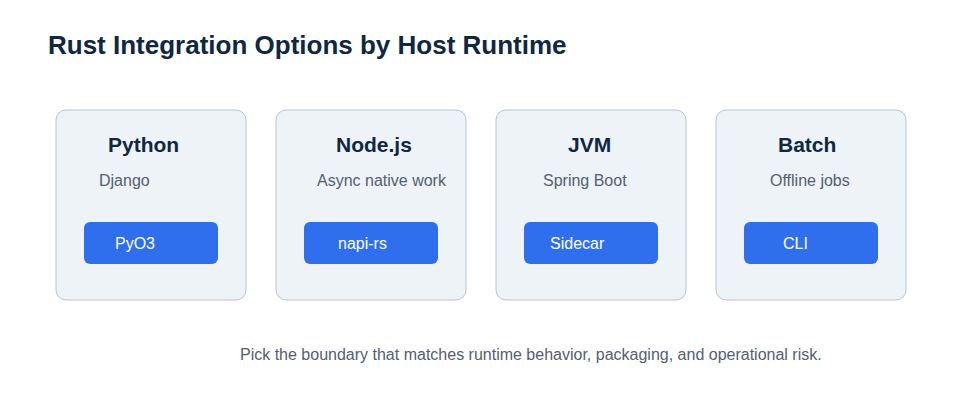
Different runtimes push teams toward different Rust integration boundaries.
Keep the Old Code on Purpose
Deleting the host implementation too early removes your best safety mechanism.
The old path gives you a test oracle, a fallback, and a rollback plan. Native artifacts fail for ordinary reasons: missing shared libraries, Linux distribution differences, architecture mismatches, container changes, or incomplete CI builds.
def calculate_payroll(rows: list[dict]) -> list[dict]:
    if not settings.USE_RUST_ACCELERATORS:
        return calculate_payroll_python(rows)

    try:
        payload = PayrollInput.from_rows(rows)
        return rust_payroll.calculate(payload).to_rows()
    except AcceleratorError:
        logger.warning(
            "payroll_accelerator_fallback",
            extra={"record_count": len(rows)},
        )
        return calculate_payroll_python(rows)
The log line records event shape, not payroll data. That distinction matters in any regulated system.
Common Pitfall: Teams often log raw payloads while debugging accelerator mismatches. Log counts, schema versions, tenant-safe identifiers, and timing buckets instead.
Prove Equivalence Before You Celebrate Speed
Rust must return the same answer before it returns it faster.
Equivalence tests run identical inputs through both implementations and compare outputs. They catch the bugs performance work tends to create: changed ordering, decimal drift, timezone mistakes, null handling differences, duplicate-key behavior, and edge cases users accidentally depend on.
flowchart LR
    A[Test input] --> B[Host path]
    A --> C[Rust path]
    B --> D[Expected]
    C --> E[Actual]
    D --> F{identical?}
    E --> F
For complex logic, add property-style tests. Generate duplicate keys, leap years, daylight saving transitions, rounding cases, and negative adjustments.
Then benchmark production-shaped inputs. A 100-row benchmark says little about a 500,000-record export. Include serialization and boundary costs. Rust can look excellent in isolation and still lose value if conversion dominates.
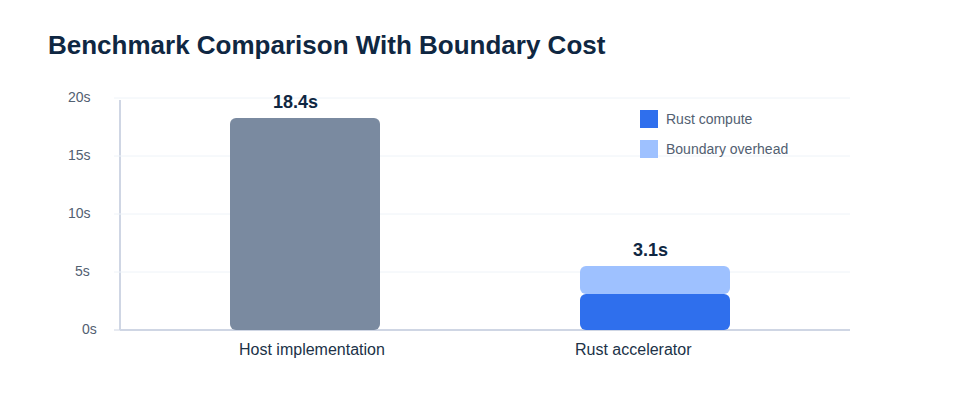
A benchmark should include the boundary cost, not just isolated Rust compute time.
Roll Out Like an Operational Change
Ship the accelerator disabled. Enable it internally. Move to a small customer segment. Watch fallback count, Rust errors, latency buckets, memory, and mismatch reports. Expand only when the signals stay boring.
Feature flags are not just product switches here. They decouple deployment from activation, a practice Pete Hodgson and Martin Fowler describe in their writing on feature toggles. For accelerators, a flag is also an emergency brake.
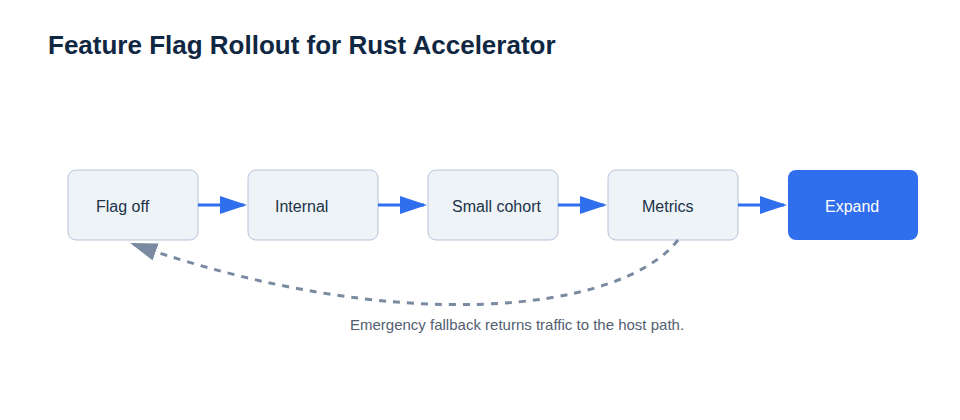
Feature flags turn accelerator rollout into an operational control.
When Not to Use Rust
Do not use Rust when the slow part is mostly I/O. Do not use it to hide a data model problem. Avoid it when the logic changes every sprint or the team cannot package, monitor, and debug the artifact in production.
Also pause when Rust needs framework internals. Request objects, ORM entities, sessions, permission state, and secrets should stay in the host. If those objects must cross the boundary, refactor first.
Production Checklist
- The bottleneck is measured and CPU-bound.
- The Rust boundary accepts and returns plain data.
- The host implementation remains available.
- Equivalence tests cover edge cases and ordering.
- Benchmarks use production-sized input.
- The rollout uses a feature flag with an emergency off path.
- Fallback behavior has a test.
- Logs avoid PII, secrets, payroll values, and raw uploads.
- CI builds the Rust artifact for supported platforms.
- On-call engineers know how to disable the accelerator.
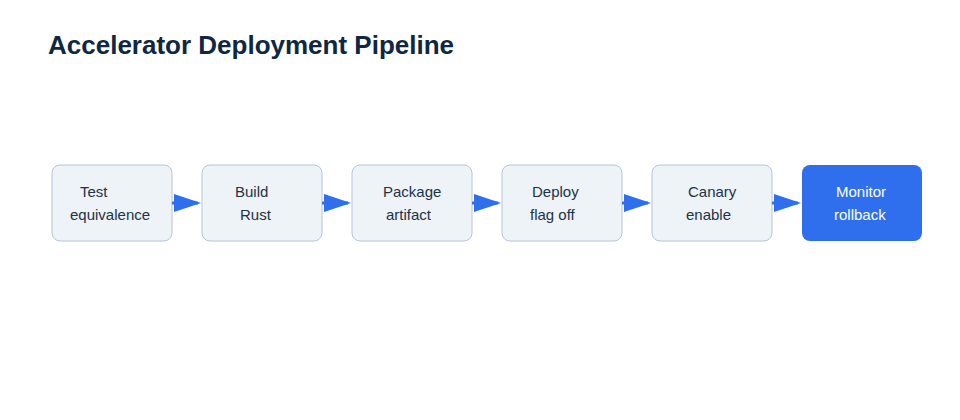
A production accelerator needs test, build, package, rollout, and rollback discipline.
The Engineering Philosophy
A mature Rust strategy does not ask how much of the system can be rewritten. It asks which small piece can be moved, proved, operated, and learned from.
That mindset changes the risk profile. The team keeps the framework that already carries the product. Rust handles the computation that deserves it. Tests protect behavior. Benchmarks protect honesty. Feature flags protect production.
The best accelerator is almost boring after it ships. It sits behind a stable wrapper, processes plain data, emits safe metrics, and gives the old path room to take over when reality misbehaves.
Use Rust where it makes the system simpler to operate, not where it makes the architecture more impressive to describe.
FAQ
Should I rewrite my backend in Rust for performance?
Usually no. Profile first. Move isolated CPU-heavy paths only when Rust provides measurable value.
Is Rust always faster than Python, Java, or Node.js?
No. Rust often helps with CPU-bound work, but it does not fix database, network, caching, or product workflow problems.
What is the safest way to introduce Rust into an existing backend?
Use a wrapper, pass plain data, keep the original implementation, test equivalence, benchmark realistic input, and roll out behind a feature flag.
Should Spring Boot use JNI or a Rust sidecar?
It depends on the deployment pipeline. Many teams find a sidecar easier to package and operate unless they already support native library distribution well.
What should never cross the Rust boundary?
Request objects, ORM models, database connections, sessions, permission context, secrets, and framework-specific runtime objects.
References
- JetBrains Rust Blog: How do you rewrite C/C++ projects to Rust?
- The Rust Programming Language: Official Rust Book
- The Rust Performance Book: Introduction
- PyO3: User Guide
- napi-rs: Official documentation
- Martin Fowler: Strangler Fig Application
- Pete Hodgson and Martin Fowler: Feature Toggles