
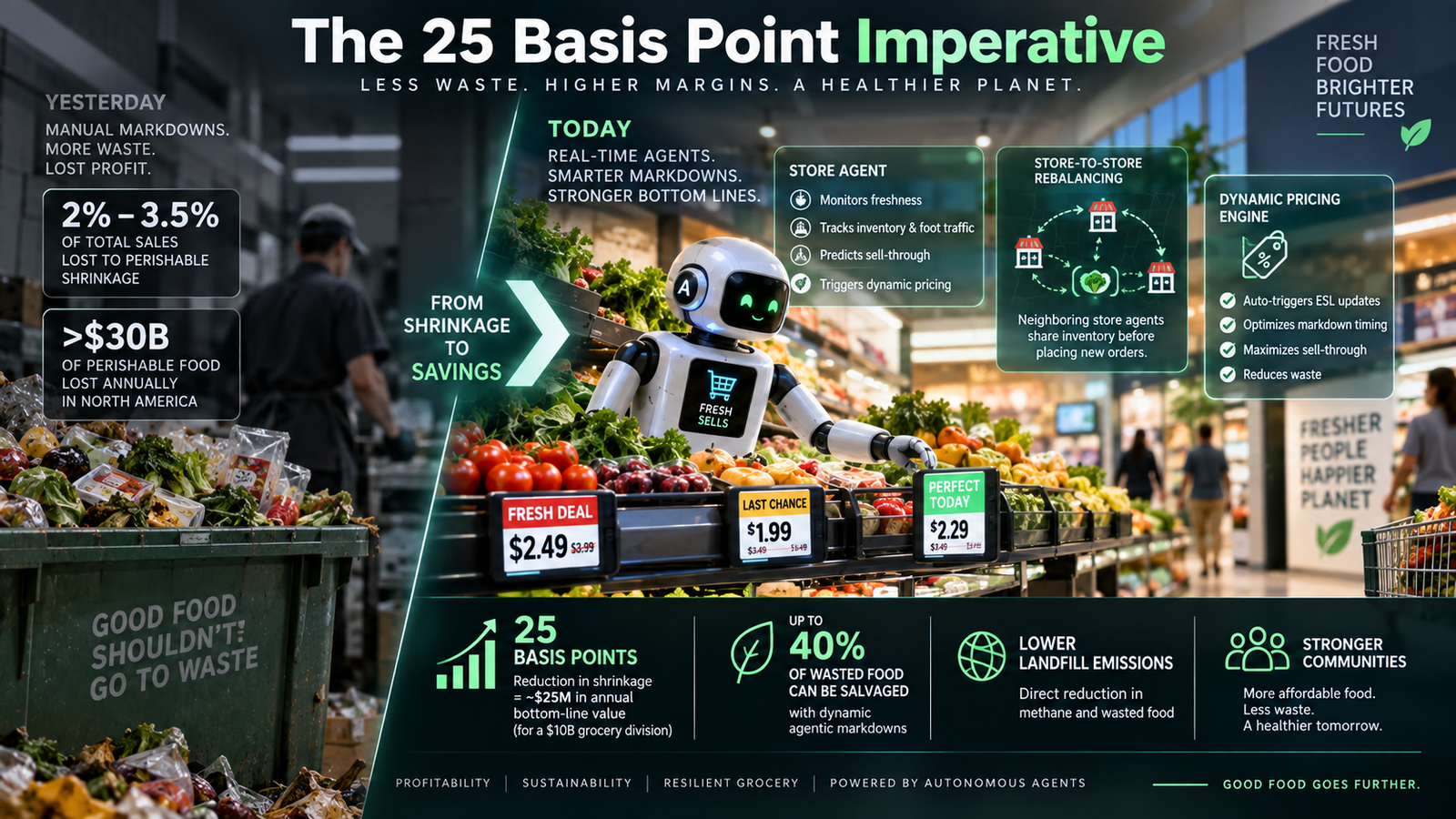
Grocery is one of the few industries where a quarter of a percent is a strategy.
That sounds like an exaggeration until you put two numbers next to each other. Grocery retail runs on operating margins in the range of one and a half to three percent. Shrink in perishable categories commonly runs several times that.
Which means the waste moving through your stores every day is not a rounding error sitting next to your profit. In many chains it is larger than your profit.
Most executives already know this in the abstract. What tends not to get stated plainly in the boardroom is the arithmetic that follows from it: because avoided shrink falls almost entirely to the bottom line, a twenty-five basis point improvement on a ten billion dollar grocery division is worth something in the order of twenty million dollars of operating income. Against a two percent operating margin, that single quarter-point is a double-digit percentage improvement in the profitability of the business.
No merchandising initiative, no private label expansion, no store remodel programme produces that ratio. And unlike those, it requires no additional sales.
Why the number has stayed stubborn
Perishable waste is not a discipline problem. Your store teams are not careless. The problem is that the decision they are asked to make is genuinely impossible with the information they are given.
A store manager marking down produce is being asked to predict, for each item, how many units will sell in the remaining hours at the current price, how many will sell at a ten percent discount, how many at thirty, and what the item will be worth tomorrow morning. They are asked to do this across thousands of SKUs, using a sticker gun, usually in the last hour of a shift.
So they do what any rational person does. They apply a rule. Mark it down a fixed percentage a fixed number of hours before the date. The rule is applied uniformly across stores that have entirely different footfall, entirely different weather and entirely different competitive intensity.
That rule is wrong in two directions simultaneously, and both are expensive.
When the discount is too shallow or too late, the product is thrown away and you lose the full cost of goods. When the discount is too deep or too early, you have given margin away on units that would have sold at full price, which is a cost that never appears in a waste report at all. The second error is almost certainly larger than the first in most chains, and almost nobody measures it.
This is the honest framing of the opportunity. It is not primarily a sustainability initiative that happens to save money. It is an information asymmetry between what the shelf knows and what the pricing decision knows, and closing it improves margin and waste at the same time.
What changes when the decision moves to the shelf
The alternative is not more sophisticated rules. It is moving the decision to where the information is, and letting it be made continuously rather than once.
An agent operating at store level can weigh remaining shelf life against the current rate of sale, against today’s traffic in that specific store, against what is already committed in the back room, and adjust the offer accordingly. Not once a day at four in the afternoon. Continuously, as conditions change, with the price on the shelf edge reflecting the answer within minutes.
The value of this compounds in a way that is easy to underestimate. Every hour that a markdown decision is late is an hour of sell-through at the wrong price. Recovering that time across every perishable SKU in every store, every day, is where the twenty million comes from. It does not come from any single heroic decision. It comes from removing a lag that currently exists thousands of times a day.
There is a second mechanism that matters at scale. Before a store reorders, a nearby store may already be holding surplus of the same item. Letting those stores resolve that between themselves converts a write-off in one location into a sale in another.
I would put a qualification on that one, because it is where these proposals usually get oversold. For most perishable items, the cost of an inter-store transfer plus the cold chain compliance burden exceeds the salvage value of the product. The agent’s most valuable contribution is frequently knowing when not to move something. Any vendor who presents peer-to-peer rebalancing as universally applicable has not run a store.
Read about agent-to-agent coordination across organisations
The part your communications team needs to read
There is a version of this that ends badly, and it ends badly in public.
Dynamic pricing in grocery is politically radioactive in North America right now. When Kroger expanded electronic shelf labels, it drew direct scrutiny from US senators over the potential for surge pricing and personalised pricing. When Wendy’s used the phrase “dynamic pricing” in an earnings call, the backlash was immediate and national, and the clarification never travelled as far as the accusation.
Any grocery executive funding shelf-edge automation should assume that a journalist will eventually write that you are raising prices on hot days.
The defence is not a communications plan. It is an architectural commitment made before launch, and it is simple enough to put in a press release: prices move in one direction only.
Markdown agents should be constrained so that the price of a perishable item can only decrease as it approaches the end of its life, never increase, and never vary by individual shopper. That is the opposite of surge pricing. It is the opposite of personalised pricing. It is a system whose entire function is to make food cheaper as it gets older, which is a proposition that survives a newspaper headline intact.
That constraint should not live in a policy document or in someone’s application code where it can quietly drift. It should be enforced structurally, so that the system is incapable of the behaviour rather than merely instructed against it, and so that you can demonstrate that to a regulator or a reporter with an audit trail rather than an assurance.
Getting this right is also a competitive asset. Your competitors will eventually deploy shelf-edge automation with fewer constraints, and one of them will have a bad news cycle. The chain that can point to a published, verifiable, one-directional pricing commitment will be the one that is not in the article.
The prerequisite nobody mentions in the pitch
Expiry-aware pricing requires the system to know when the item expires.
That sounds obvious. It is also the reason most of these programmes stall, because in the majority of grocery estates the point of sale knows the product and the price but has no idea of the date, the batch or the remaining life. The barcode was designed decades ago to identify a product category, not an individual unit with a history.
This is changing, and the timing is the strategic point. The retail industry is moving to two-dimensional barcodes capable of carrying batch and expiry data, with the coordinated transition targeted for 2027. Chains that have done this groundwork will be able to act on item-level freshness. Chains that have not will be running sophisticated agents on top of data that cannot tell Tuesday’s delivery from Friday’s.
If there is one instruction to give your team this quarter, it is to find out where you actually stand on item-level product identity, because it determines whether any of the rest is available to you in 2027 or 2030.
The sustainability case, stated without the usual softness
Around thirty billion dollars of perishable food is lost annually in North American grocery supply chains. Food that reaches landfill decomposes anaerobically and generates methane, a greenhouse gas with far greater near-term warming impact than carbon dioxide.
Most sustainability initiatives ask a CFO to accept a cost today for a reporting benefit later. This one does not. The waste reduction and the margin improvement are the same event, measured by two different departments.
That makes it unusual, and it makes it defensible in a way that carbon offset purchasing is not. When food waste reporting requirements tighten, and they are tightening across most major markets, you will be reporting a number that went down because you made money, not because you spent it.
I would still be careful with the claims. Be precise about what portion of waste is genuinely addressable through pricing, because a meaningful share of grocery shrink is damage, theft and handling loss that no markdown agent will touch. Overclaiming here is how good programmes lose credibility in year two.
Where to start
Do not start with a chain-wide rollout, and do not start with the categories that have the most waste.
Start with a defined set of stores and a matched control group, and agree the baseline measurement before anything is deployed. This is the step that gets skipped, and skipping it is why so many of these programmes cannot prove their value at the end of the year. If you cannot demonstrate that the improvement was not just a mild summer, your finance team will not fund phase two, and they will be right not to.
Pick categories where shelf life is short enough that the decision genuinely changes daily. Keep a human approval gate on price changes above a threshold you set, and keep it there until the system has earned its way past it. Treat the constraint that prices only fall as non-negotiable from day one, not as something to add once the model is working.
And measure the margin you stopped giving away, not just the waste you stopped throwing out. That second number is the one that will surprise you.
Every evening, in every store you operate, someone with a sticker gun is making a pricing decision worth more than they know, with less information than they need.
FAQ’s
How much is perishable shrink actually costing a grocery retailer? Perishable shrink commonly runs at a multiple of grocery’s one and a half to three percent operating margin, which means avoided waste flows almost directly to operating income. A twenty-five basis point improvement on a $10 billion division is worth roughly $20 million of operating profit.
What is a markdown agent? Software that continuously evaluates remaining shelf life, current rate of sale and store-level conditions, then adjusts the price at the shelf edge, rather than applying a fixed discount at a fixed time before expiry.
Is this the same as surge pricing? No, and the distinction should be architectural rather than a matter of policy. Markdown agents should be constrained so prices only decrease as a product ages, never increase, and never vary by individual shopper.
What does a retailer need in place first? Item-level product identity. Most point-of-sale systems know the product but not the batch or expiry date. The industry transition to two-dimensional barcodes carrying batch and expiry information, targeted for 2027, is the enabling prerequisite.
Is the environmental benefit real or incidental? Both, and they are the same event. Roughly $30 billion of perishable food is lost annually in North American grocery supply chains, and food in landfill generates methane. Reducing that waste and improving margin are not competing objectives here.