
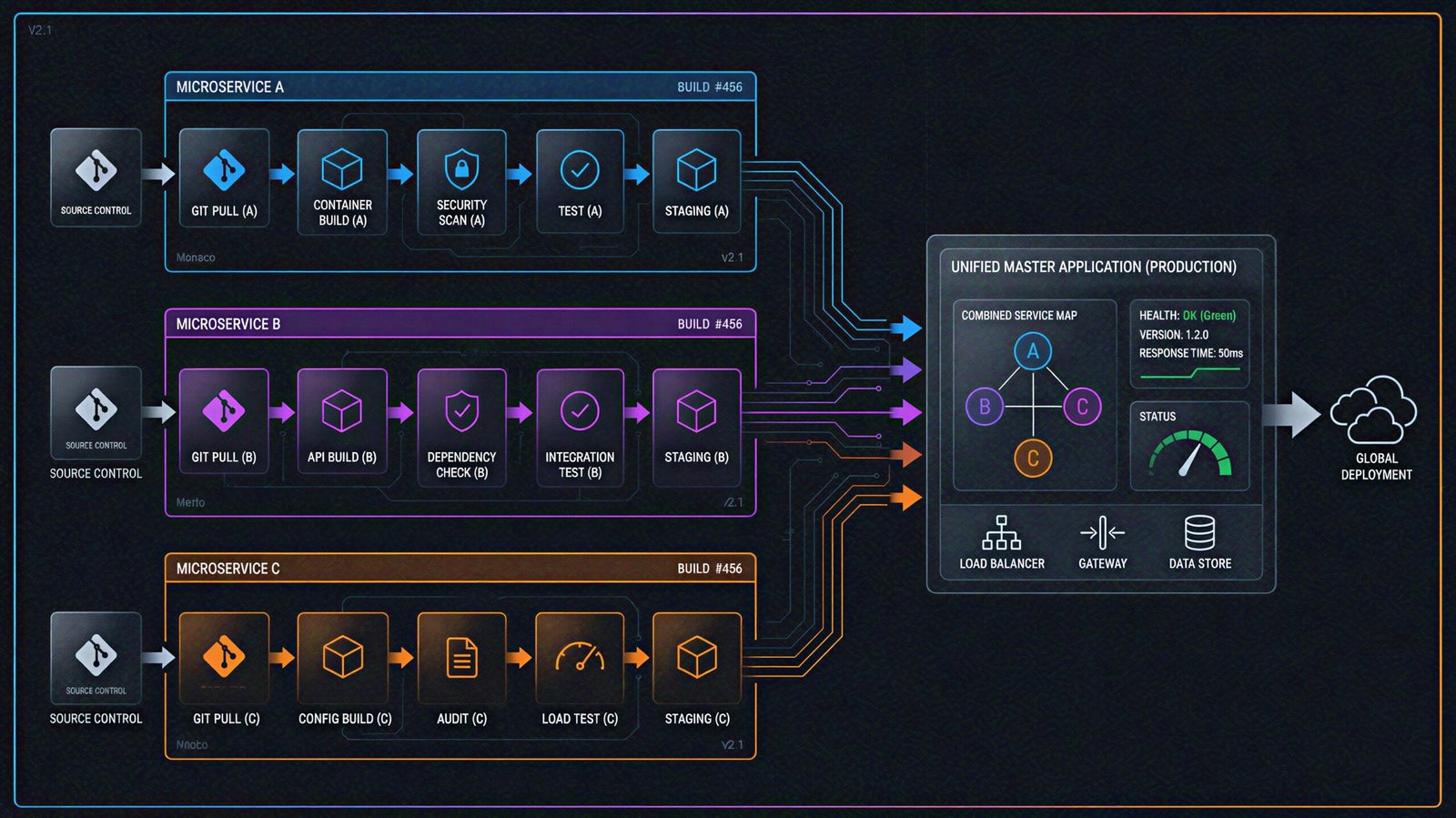
At its core, a micro-frontend architecture establishes a resilient frontend boundary around an independently owned business capability. It extends core software design patterns such as SOLID principles, high cohesion, and low coupling out of the code level and directly into distributed web systems. By packaging complete vertical slices behind explicit contracts, teams can build, evolve, and deploy end-to-end business domains in lockstep with backend microservices.
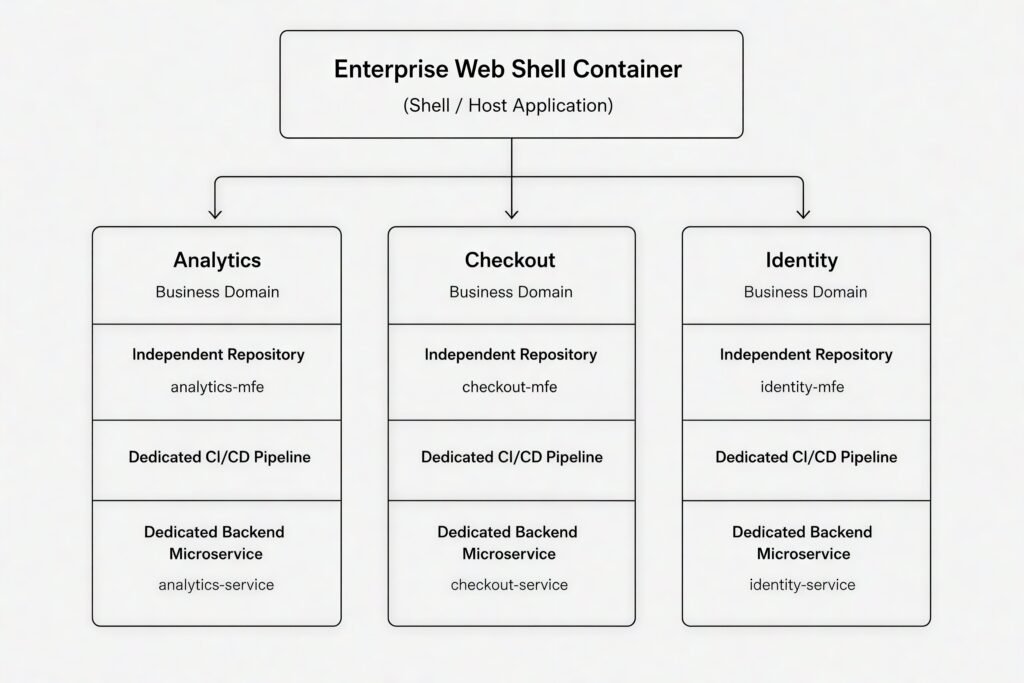
1. The Architectural “Why”: From SOLID Principles to Domain Boundaries
When backend engineering evolved from monoliths to microservices, the driving goal was domain isolation: ensuring a single business capability could change without requiring sweeping modifications across unrelated systems. Micro-frontends complete this cycle by aligning the client layer with the exact same distributed principles.
- Single Responsibility at Architectural Scale: Just as a class should have only one reason to change, a micro-frontend encapsulates a single business domain. A change in compliance logging rules or payment flows remains isolated to its specific bounded context.
- Interface Segregation and Dependency Inversion: Host shells and remotes communicate exclusively through strictly typed, minimal runtime contracts. The host does not depend on the remote’s internal framework state, and the remote does not directly touch host implementations.
- True Vertical Slices (Beyond Code Splitting): Traditional SPAs organize code by technical layers such as UI components, API services, and global stores. Micro-frontends organize systems by business capabilities, pairing frontend modules directly with corresponding backend microservices.
- Decoupled Delivery Lifecycles: When business boundaries are enforced, autonomous teams ship features independently without cross-domain regression testing or coordinated multi-team release trains.
2. The “When”: Adoption Decision Scorecard
Because distributed boundaries introduce operational overhead, applying micro-frontends to an undifferentiated or tightly coupled UI will cause friction. If your features share high internal cohesion, keep them inside a modular monolith.
Use this decision matrix to evaluate your readiness:
| Evaluation Dimension | Stick with a Modular Monolith | Ready for Micro-Frontends |
| Domain Alignment | Fluid, overlapping feature areas with shared global state | Clearly delineated business capabilities and bounded contexts |
| Team Topology | 1 to 2 frontend squads ($< 15$ engineers) with shared goals | $4+$ autonomous vertical squads ($30+$ engineers) owning distinct domains |
| Backend Architecture | Unified backend monolith or tightly coupled APIs | Distributed microservices mapped to business units |
| Deployment Needs | Unified bi-weekly or scheduled release trains | Multiple teams requiring independent daily production deployments |
| Contract Governance | Internal function calls and shared component libraries | Explicit, versioned contracts verified in automated CI |
Rule of Thumb: If your domain boundaries are still evolving, keep your application in a well-structured modular monolith using tooling like Nx. Migrate to micro-frontends only when your bounded contexts are mature enough to justify distinct operational boundaries.
3. The “How”: Choosing the Right Integration Pattern
Integrating distributed capabilities into a cohesive user journey requires balancing user experience, isolation, and contract safety.
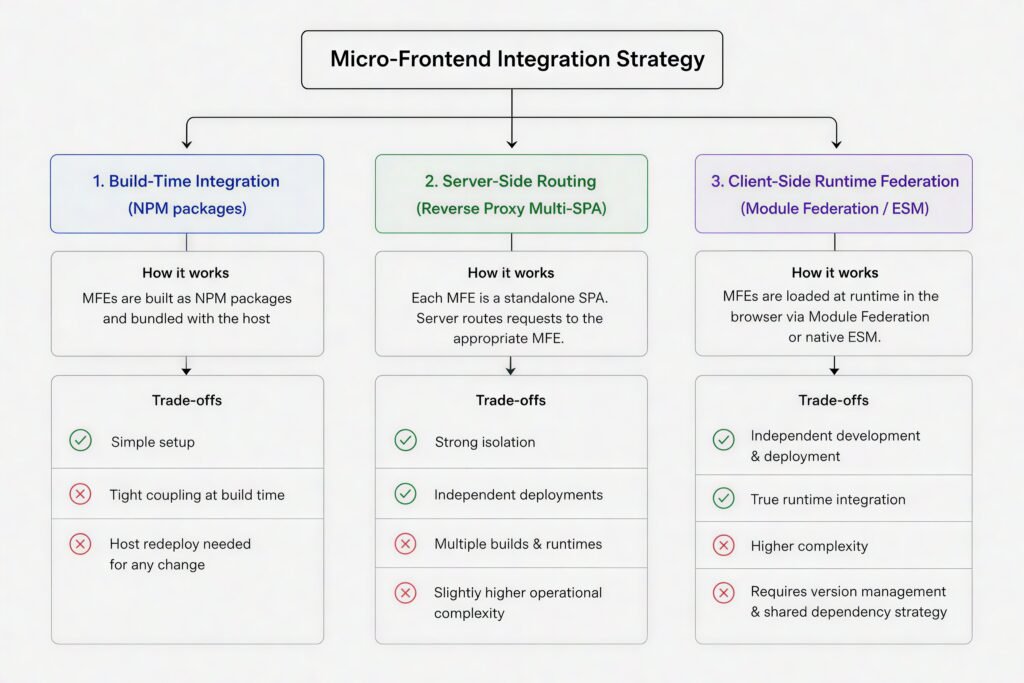
A. Build-Time Integration (NPM / Monorepo Packages)
Capabilities are packaged as internal libraries and compiled into a single artifact at build time.
- Trade-off: Strong compile-time typing, but changing any single domain capability requires a full host application build, breaking deployment autonomy.
B. Server-Side Routing (Multi-SPA Reverse Proxy)
A reverse proxy routes distinct URL paths such as /billing/* and /analytics/* to isolated single-page applications.
- Trade-off: Ideal domain isolation and zero shared runtime state, but page transitions trigger full browser reloads.
C. Client-Side Runtime Federation
A lightweight host shell dynamically imports remote bundles in the browser using Module Federation
or dynamic ES Module loaders.
- Trade-off: Delivers a seamless single-page user experience while allowing independent deployments, but demands strict contract versioning, clean teardown lifecycles, and style containment.
When implementing client-side runtime federation, your remote modules must maintain clean separation from the host environment without leaking styles or token lifecycles. For an actionable deep-dive into implementing contracts, dynamic lifecycle mounting, and zero-trust authentication, read our companion guide: The Production Micro-Frontends Playbook: Contracts, Lifecycle Hooks, and Zero-Trust Auth.
4. Architectural Ground Rules for Clean Boundaries
To maintain low coupling and prevent your distributed frontend from turning into a distributed mess, adhere to these operational ground rules:
Rule 1: Communicate via Explicit Structural Contracts
Treat the host-remote boundary as an immutable interface. Pass only primitive data, semantic version identifiers, and asynchronous functions across the boundary, never framework-specific state stores or class instances.
// Explicit Boundary Contract Definition
export interface MfeHostContext {
  contractVersion: string;
  baseHref: string;
  theme: 'light' | 'dark';
  getAccessToken: () => Promise<string>;
  navigateByUrl: (url: string) => void;
}
Rule 2: Keep Capabilities Stateless Regarding Authentication
Business capability modules should not manage persistent authentication tokens or refresh loops. The host shell acts as the single source of truth for identity, supplying fresh tokens to the remote on-demand.
Rule 3: Enforce UI Scope Containment
Prevent cross-domain styling collisions by namespacing all styles and design tokens under a root scope selector such as .capability-scope. Ensure dynamic floating elements like tooltips, modals, and dropdowns automatically inherit this scope when rendering into the DOM body.
Key Takeaways
- Domain Boundaries First: Micro-frontends are an architectural mechanism to encapsulate business capabilities with high cohesion and low coupling, mapping the frontend cleanly to microservice backends.
- Applied SOLID Principles: By leveraging clean contracts and dependency inversion, remotes can evolve their internal implementations without destabilizing the host container.
- Strategic Adoption: Evaluate your organization against team topology and domain maturity before adopting distributed frontends; small teams should maximize a modular monolith first.
Frequently Asked Questions
How do micro-frontends relate to microservices?
Micro-frontends represent the frontend layer of a vertical microservice slice. Instead of maintaining a monolithic frontend that calls multiple independent microservices, each cross-functional team owns their business capability from the database and API all the way up to the user interface.
How should independent capabilities share UI state?
Cross-capability state sharing should be minimized. Treat each micro-frontend as an isolated domain, relying on URL route parameters as the primary mechanism for state synchronization. For lightweight notifications, use typed, contract-governed custom event emitters rather than shared global stores.
Does a micro-frontend architecture force the use of multiple frameworks?
No. In fact, most enterprise teams standardize on a single core framework (such as Angular, React, or Vue) to share caching and avoid downloading duplicate runtime libraries. The value of micro-frontends lies in independent team autonomy and domain boundaries, not in running different UI frameworks on the same screen.