
Enterprise Agentic AI Design: The Question That Stopped the Room
We were four slides into the demo. The client’s compliance officer raised her hand. She asked something we hadn’t fully prepared for: “Can you show me exactly why the agent made this decision, for this customer, on this date?”
The agent had approved a refund exception. A reasonable one, on the surface. But she wasn’t asking whether the decision made sense. She was asking whether we could reconstruct it — the inputs, the tool calls, the policy checks, the model version, all of it. Six months later. For an auditor who’d never seen our system before.
We could. Barely. And that gap — between “the agent works” and “the agent’s behavior is provable” — is the entire subject of enterprise agentic AI design that nobody puts in the sales deck.
Why a Working Demo Isn’t a Production System
A prototype agent needs to do the right thing most of the time. An enterprise agent carries three separate obligations. It has to do the right thing every time. It has to prove that afterward. And it has to fail in a contained, explainable way when it inevitably doesn’t. Most agentic AI content online only covers the first one.
That compliance meeting changed how we think about enterprise agentic AI design for every engagement since. It’s not “build an agent that works.” It’s “build an agent whose behavior an outside party can trust without trusting you.
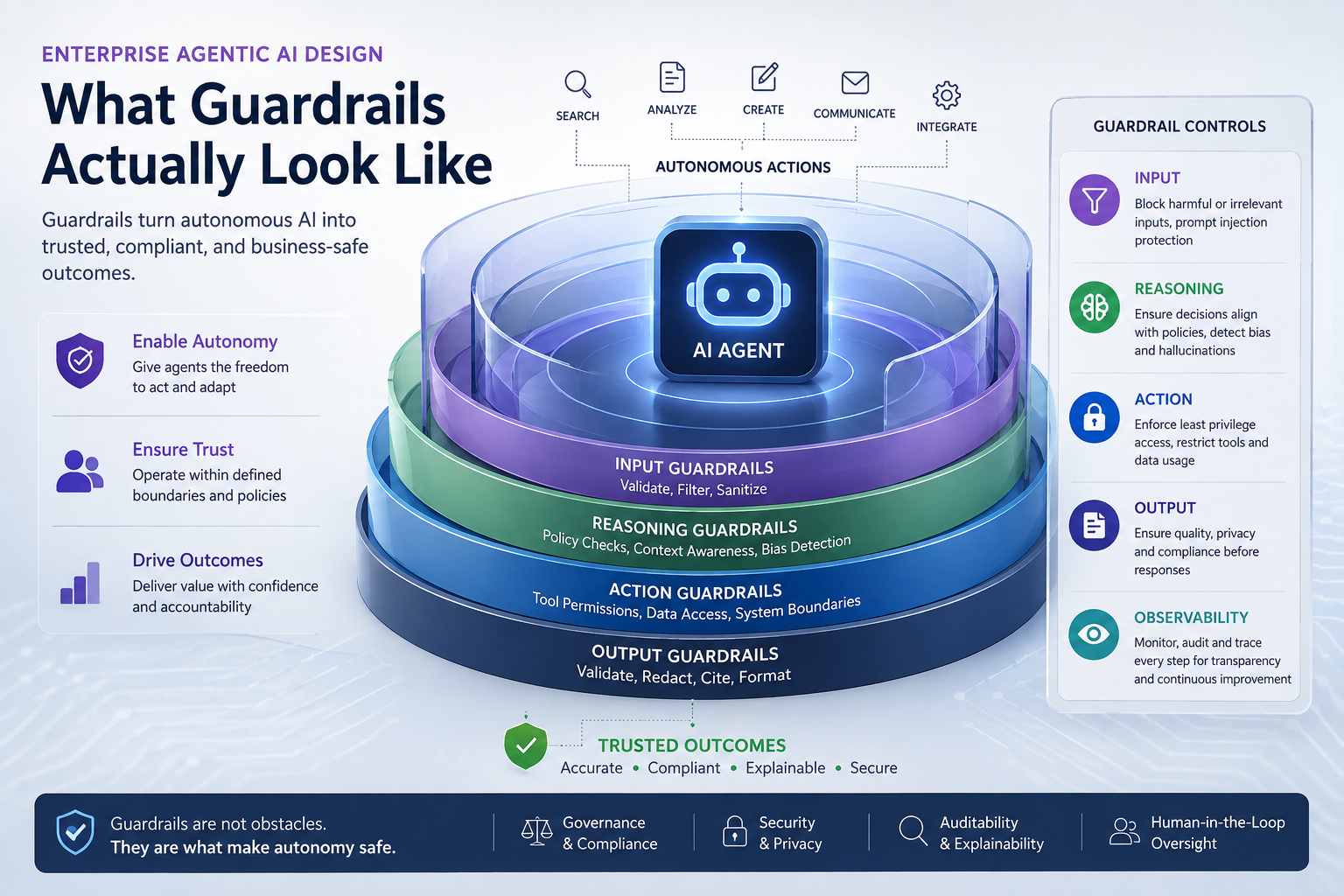
Guardrails: The Boundary, Not the Afterthought
Teams often treat guardrails as a wrapper they bolt on before launch — a content filter here, a rate limiter there. We treat them as structural, not cosmetic.
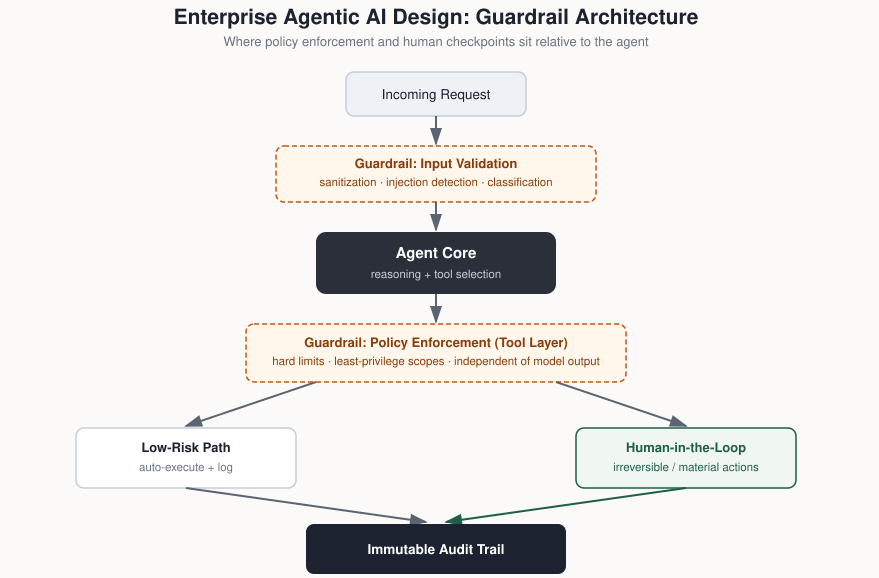
Input validation before the model sees anything. We sanitize and classify incoming requests before they reach the agent. That way, prompt injection attempts and malformed tool arguments get caught at the boundary, not mid-execution.
Policy enforcement at the tool layer, not the prompt layer. Telling an agent “don’t approve refunds over $500” in a system prompt is a suggestion. A hard check in the tool-execution layer, independent of what the model decides — that’s a guardrail. If the check only lives in language, it isn’t a guardrail. It’s a hope.
Human-in-the-loop for the decisions that matter. Not every action needs a human. But anything irreversible, financially material, or customer-facing in a regulated way should route to a human checkpoint by default. Risk sets that threshold, not convenience.
Data Governance: Where Most Agentic Systems Quietly Fail
Agentic systems touch more data surface than a traditional application. Tool calls fan out to retrieval systems, APIs, and databases that were never built for an autonomous caller. A few things we now treat as non-negotiable in enterprise agentic AI design:
Least-privilege tool access. An agent shouldn’t hold a database credential with more permission than the task requires. Scope every tool integration to the narrowest access that still lets the agent do its job.
Data lineage and residency. For clients with cross-border operations, we need to know where each piece of data traveled — which vector store, which region, which model call. That’s not a nice-to-have. It’s the difference between a clean data governance posture and an uncomfortable legal conversation.
PII handling at the retrieval boundary. Redaction and masking need to happen before data reaches the model context, not as a filter on the output afterward. Once sensitive data sits inside a prompt, the model has already seen it.
Auditability: Build the Trail Before You Need It
Here’s the lesson from that compliance meeting, stated plainly: if you can’t reconstruct a decision after the fact, you don’t have an audit trail. You have logs. The difference matters.
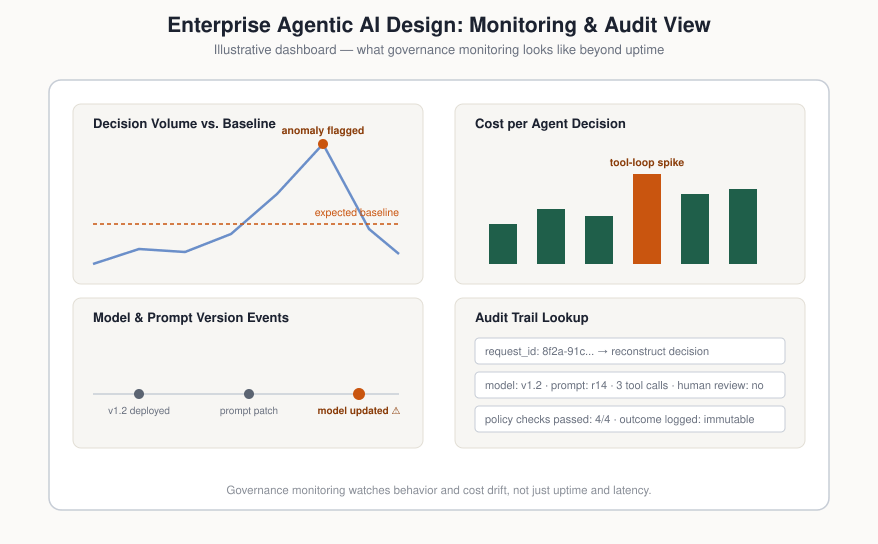
A real audit trail for an agentic system captures the exact input, the model and prompt version in effect at that moment, every tool call and its result, and any policy check that fired. It stores the final output immutably, indexes it by request, and keeps it retrievable months later without archaeology. Retrofitting this after a client asks for it is painful. Designing it in from the first agent phase costs little more, and it’s the single highest-leverage thing we do differently now
Monitoring: Watching for Drift, Not Just Downtime
Traditional application monitoring watches uptime and latency. Enterprise agentic AI design needs a second layer on top of that. Is the agent still behaving the way it did when it was approved?
That means a few things. Track model and prompt version changes as deployment events. Watch for behavioral drift when an underlying model gets an update upstream. Alert on unusual tool-call patterns — an agent suddenly calling a refund tool ten times more than its baseline is a signal, not noise. And treat cost-per-decision as a monitored metric, because agentic systems can turn expensive quietly once a workflow starts looping or over-calling tools.
What We’d Add If You’re Building This Yourself
A few things don’t fit neatly under the four headings above, but they matter just as much:
- Evaluation before every deployment, not just at launch. Run a regression suite against real historical decisions whenever the model, prompt, or tool set changes.
- Versioning and rollback for prompts and agent configurations. Give them the same discipline as application code, not a set of notes in a doc somewhere.
- An incident response playbook specific to agent behavior, separate from your standard outage playbook. “The agent did something wrong” and “the agent went down” call for different first responses.
- Compliance mapping done early, against whatever frameworks apply to your industry. Don’t reverse-engineer it when a client’s legal team asks. The NIST AI Risk Management Framework and the OWASP Top 10 for LLM Applications are both solid starting points.
None of this is exotic engineering. It’s mostly discipline, applied early, in places where it’s tempting to defer.
The Standard We Actually Hold Ourselves To
Enterprise agentic AI design isn’t a harder version of the prototype you already built. It’s a different obligation entirely. The system has to earn trust from people who will never see your code, never sit in your standups, and never take your word for it. If you’re evaluating what that standard looks like for your own stack, this is the kind of production AI engineering work we do.
We passed that compliance review, eventually. But the real lesson wasn’t “we got lucky with the questions.” The agent should have answered that question before the officer ever asked it.