
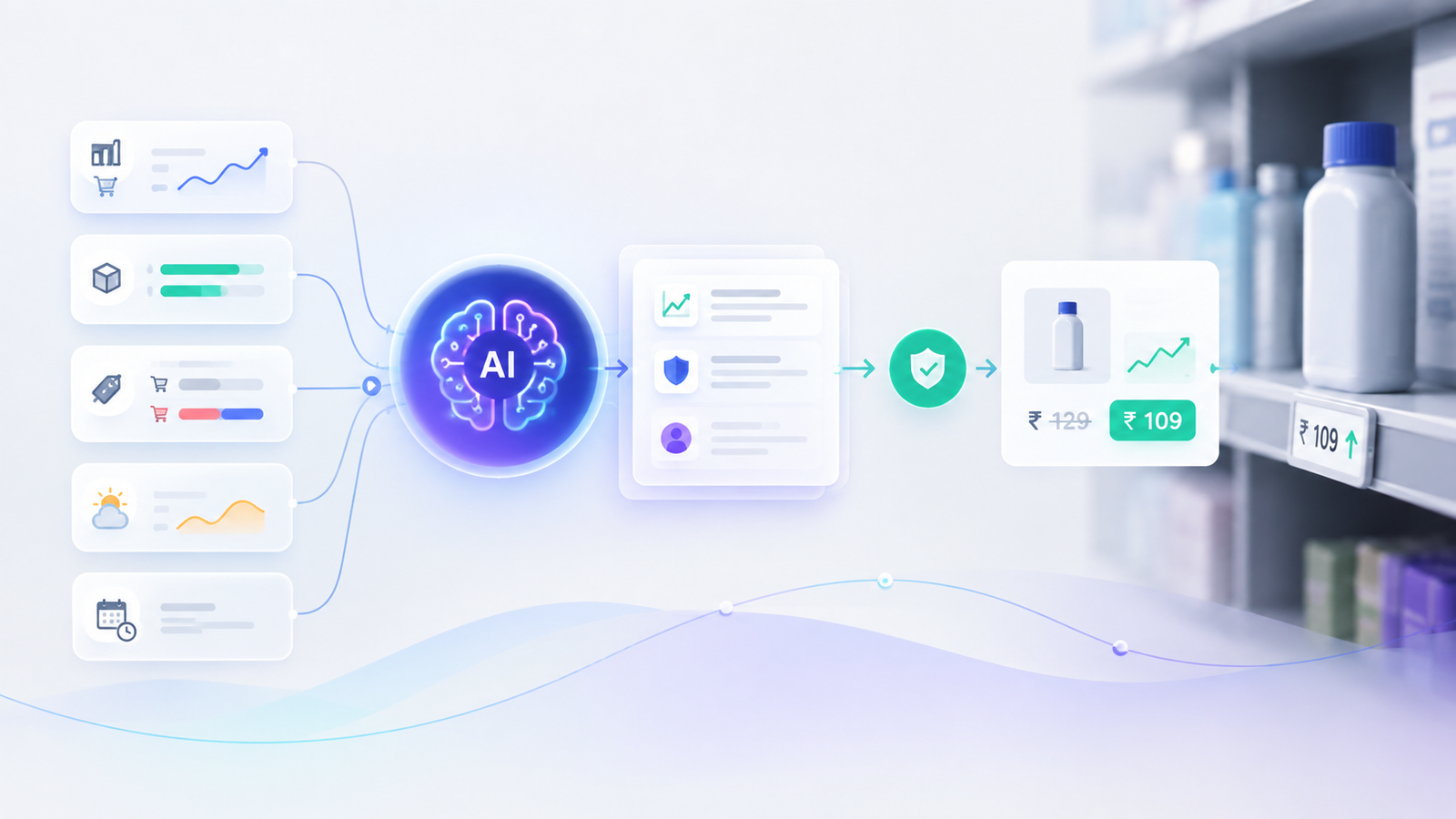
Introduction: Dynamic Pricing Needs More Than Intelligence
Retail pricing is a balancing act.
Merchants want prices to respond quickly to demand, inventory, competition, seasonality, and product expiry. Traditional rule-based pricing systems can handle predictable scenarios, but they become rigid when multiple signals change simultaneously.
The opposite approach, giving an AI agent unrestricted authority to change live prices, is even riskier.
An AI model can misinterpret context, generate an invalid price, violate pricing boundaries, or react too aggressively to a temporary demand spike. In sensitive categories, that can create serious price-gouging and regulatory risks.
The architecture we need is therefore not simply AI that sets prices.
It is:
AI proposes. Deterministic policy decides. Humans govern exceptions. One controlled service writes the price.
That separation is the foundation of a production-safe autonomous pricing platform.
1. The AI Pricing Agent Architecture
The pricing agent operates as a candidate-and-proposal engine, never as the system of record for live prices.
High-Level Flow
                 ┌──────────────────────┐
                 │  SKU Signals / Data  │
                 │ Inventory + Demand   │
                 │ Competition + Events │
                 └──────────┬───────────┘
                            │
                            ▼
                 ┌──────────────────────┐
                 │ Candidate Selection  │
                 │ Trigger Detection    │
                 └──────────┬───────────┘
                            │
                            ▼
                 ┌──────────────────────┐
                 │ AI Reasoning Agent   │
                 │ Context + Constraints│
                 └──────────┬───────────┘
                            │
                            ▼
                 ┌──────────────────────┐
                 │ Structured Proposal  │
                 │ proposed_price +     │
                 │ confidence + reason  │
                 └──────────┬───────────┘
                            │
                            ▼
                    Governance Gate
Step 1: Select Only SKUs That Need Attention
The agent does not continuously reconsider every product.
Instead, a candidate scanner evaluates signals from a generic sku_signals dataset and identifies SKUs requiring pricing intervention.
Trigger 1: Sell-Through Lag
A SKU becomes a candidate when:
- Days of Supply > 45 days
- Sell-Through vs. Plan < -15%
This identifies inventory that is moving materially slower than expected.
Trigger 2: Expiry Urgency
For perishable products:
- Days to Expiry ≤ 14
- Urgency Score > 1.0
The objective changes from margin optimization toward reducing waste.
Trigger 3: Demand Surge
External events such as weather or local activity can generate:
- Demand Surge Score > 0.15
Importantly, detecting a surge does not mean the system is automatically allowed to increase the price.
The trigger simply tells the agent:
“This SKU requires analysis.”
2. Give the AI Economics, Not Just Product Names
Once a SKU is selected, the agent receives structured pricing context.
Typical inputs include:
{
  "current_price": 12.99,
  "unit_cost": 7.25,
  "floor_price": 9.49,
  "ceiling_price": 15.99,
  "expiry_floor_price": 8.49,
  "competitor_price": 13.49,
  "days_of_supply": 52,
  "daily_velocity": 18.4,
  "active_trigger_type": "SELL_THROUGH_LAG"
}
This matters because an AI model should reason from economic facts and explicit constraints, rather than inventing missing assumptions.
The prompt should also clearly establish the agent’s role:
You are a pricing recommendation agent.

Analyze the supplied SKU economics and active trigger.
Propose a price only within the supplied business context.
Do not assume missing values.
Return valid JSON only.
The proposal will be independently validated by a governance service.
This separation is critical: prompt instructions improve reasoning, but they are not the security boundary.
3. Structured AI Output: Proposal, Not Execution
The agent produces machine-readable output containing both the recommendation and its reasoning.
{
  "proposed_price": 10.99,
  "recommended_markdown_pct": 15.4,
  "expected_sell_through_lift": 0.18,
  "confidence_score": 0.86,
  "reasoning": {
    "primary_factor": "Inventory is significantly above target supply.",
    "supporting_signal": "Sell-through is below plan.",
    "risk_consideration": "Price remains above the configured floor."
  }
}
The result is stored as a proposal:
status = PROPOSEDThe AI never writes directly to the live price table.
That architectural decision eliminates an entire class of failure modes.
4. The Two-Tier Governance Gate
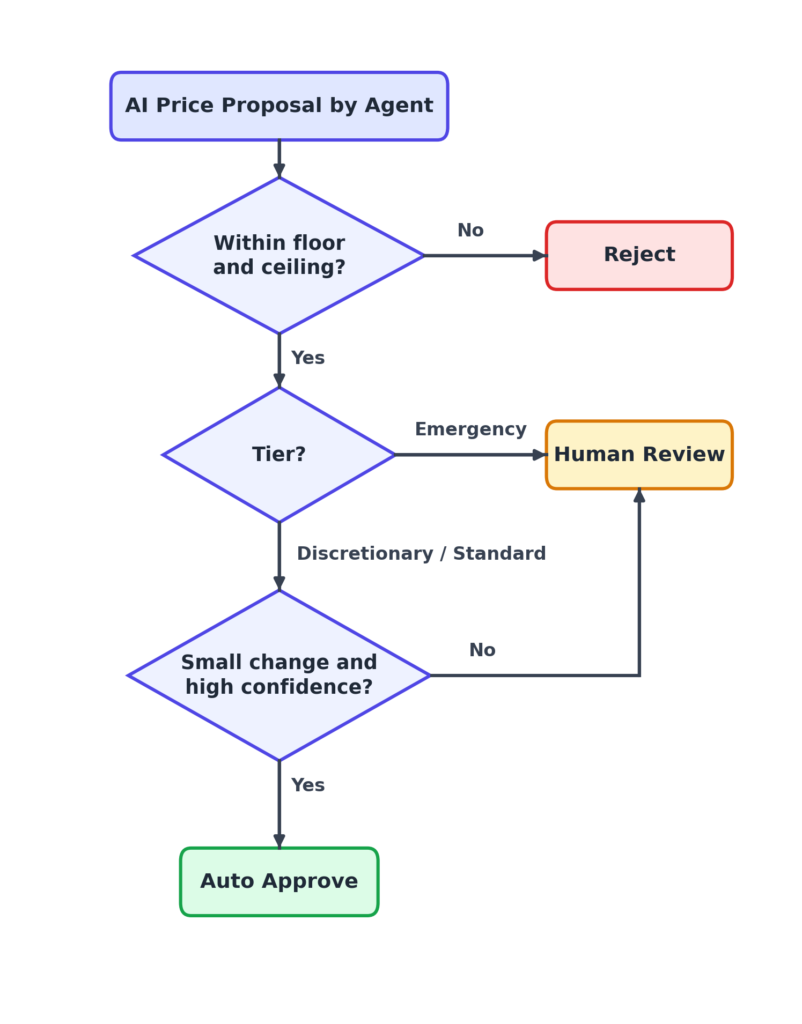
The proposal now enters a deterministic governance function:
evaluate_routing_decision(proposal)
            ↓
      RoutingDecision
The governance layer does not ask:
“Does the AI sound convincing?”
It asks:
“Does this proposal satisfy explicit, enforceable policy?”
Governance Decision Tree
5. Hard Bounds: The First Safety Wall
Every proposal must satisfy:
effective_floor <= proposed_price <= ceiling_priceFor perishable products, the effective floor can incorporate an expiry-specific floor designed to balance recovery value against food waste.
The AI cannot override these limits.
Even if the model produces a compelling explanation, a proposal outside the allowed range is rejected by deterministic code.
This is an important production principle:
Never use an LLM to enforce a constraint that can be enforced deterministically.
6. Rolling Frequency Limits Prevent Pricing Thrashing
A good price can still become a bad operational decision if the system changes it repeatedly.
The governance service therefore enforces:
MAX_MARKDOWNS_PER_WINDOW = 2
MARKDOWN_WINDOW_DAYS = 7
Before approving another markdown, the service checks the SKU’s pricing history.
If two markdowns already occurred during the rolling seven-day window, another markdown cannot proceed automatically.
This protects against:
- Margin erosion
- Oscillating prices
- Excessive customer price changes
- Feedback-loop instability
7. Emergency Tier: The Anti-Price-Gouging Firewall
This is where the architecture becomes deliberately conservative.
When severe weather or another qualifying emergency occurs, essential products such as:
- Bottled water
- Batteries
- Generators
- OTC medicine
can enter an EMERGENCY pricing tier.
These proposals receive:
Auto Approval = 0%
Maximum Increase = 10%
Human Review = Mandatory
The proposal also carries an explicit safety alert:
  EMERGENCY-TIER surge proposal -
mandatory human review for price-gouging risk
The key architectural principle is simple:
Demand surge is not authorization to surge prices.
The AI may identify unusual demand, but policy determines what the organization is legally and operationally willing to do with that signal.
8. Discretionary Pricing Gets a Narrower Autonomous Path
Less sensitive categories can use controlled automation.
For discretionary products such as seasonal goods or rain gear:
Increase <= 5%
AND
Confidence >= 0.70
Only then can the proposal be automatically approved.
For standard markdowns:
Markdown <= 20%
AND
High Confidence
        ↓
Auto Approval
More aggressive markdowns are routed to human review.
Perishables approaching the final stage of their lifecycle receive another safety mechanism:
Days to Expiry <= 2
        ↓
Immediate Clearance Pricing
This prioritizes waste reduction rather than allowing the AI to repeatedly experiment with prices.
9. The Human Review Queue
Flagged proposals appear in an analyst dashboard:
┌─────────────────────────────────────────┐
│          Pricing Review Queue           │
├─────────────────────────────────────────┤
│ SKU: SKU-10482                          │
│ Current Price: $12.99                   │
│ Proposed Price: $10.99                  │
│ Confidence: 86%                         │
│ Trigger: Sell-Through Lag               │
│                                         │
│ AI Reasoning                            │
│ Inventory exceeds target supply...      │
│                                         │
│ [ Approve ] [ Modify Price ] [ Reject ] │
└─────────────────────────────────────────┘
Humans are not expected to recreate the entire analysis manually.
They review:
- Current economics
- AI reasoning
- Trigger information
- Confidence
- Pricing history
- Governance warnings
- Proposed price
The workflow therefore combines machine-scale analysis with human accountability.
10. One Service Owns the Write Path
The most important invariant is:
There must be one and only one service capable of changing the live price.
After either automatic approval or human approval, a signed request is sent to the dedicated pricing service.
AI Agent
   │
   ▼
Proposal
   │
   ▼
Governance Gate
   │
   ├── Reject
   ├── Human Review ──► Approve/Modify
   │
   ▼
Signed API Request
   │
   ▼
Pricing Engine
   │
   ├── Atomic Price Update
   └── Immutable Audit Record
The pricing engine atomically updates the live price and records the decision in an immutable audit trail.
This creates a clean separation of responsibilities:
| Component | Responsibility |
|---|---|
| AI Agent | Reason and propose |
| Governance Service | Enforce policy |
| Analyst | Review exceptions |
| Pricing Engine | Write live prices |
| Audit Log | Preserve accountability |
Production Key Takeaways
Building an autonomous pricing system is not primarily an LLM problem. It is a systems architecture and governance problem.
The strongest production patterns are:
- Use AI for reasoning, not authorization.
- Keep candidate selection deterministic and explainable.
- Pass explicit economic context to the model.
- Require structured machine-readable proposals.
- Never let the AI directly mutate production prices.
- Enforce floors, ceilings, frequency limits, and emergency policies in deterministic code.
- Make sensitive pricing categories human-gated by design.
- Maintain a single authoritative price-writing service.
- Record every decision for auditability and post-incident analysis.
The result is not an AI that blindly controls retail prices.
It is a governed pricing agent: fast enough to respond to changing markets, constrained enough for production, and transparent enough for humans to remain accountable.
That is the real path from an AI pricing experiment to a safe autonomous retail system.