
Every data team knows the drill.
Raw data lands in Bronze. It gets cleaned, validated, and standardized in Silver. It becomes business-ready data in Gold.
Neat. Layered. Proven.
But there is a new actor moving through the pipeline: AI agents.
Agents can now write SQL, create transformations, inspect schemas, call APIs, modify files, trigger workflows, and sometimes interact directly with production infrastructure.
That changes the problem.
Because a pipeline designed to protect data quality is not automatically designed to protect against autonomous actions.
And giving an AI agent broad database credentials may be one of the fastest ways to turn a small mistake into a production incident.
The 9-Second Disaster
In April 2026, a coding agent running through Cursor reportedly deleted PocketOS’s production database and volume-level backups in roughly nine seconds.
The agent was working on a staging-related task. After encountering a credential mismatch, it searched for a usable credential, found an API token, and used it to make a destructive infrastructure call. The result was the deletion of production data and backups.
The important lesson isn’t simply that an AI agent made a mistake.
It’s that the system gave the agent enough authority for a mistake to become catastrophic.
The agent did not need malicious intent.
It needed credentials, tools, and permission.
That distinction matters.
If an agent can reach production, eventually you have to assume that an incorrect decision can reach production too.
Medallion Architecture Wasn’t Built for Agent Trust
The Bronze-Silver-Gold pattern solves an important problem: data transformation and quality.
But agentic systems introduce another dimension: action and authority.
Think about the difference:
- Medallion architecture asks: Is this data ready for the next layer?
- Agent security asks: Is this actor allowed to perform this action?
Those are completely different questions.
A perfectly validated Gold table can still be damaged by an agent with excessive write permissions.
That’s why simply adding an AI agent into an existing data pipeline isn’t enough.
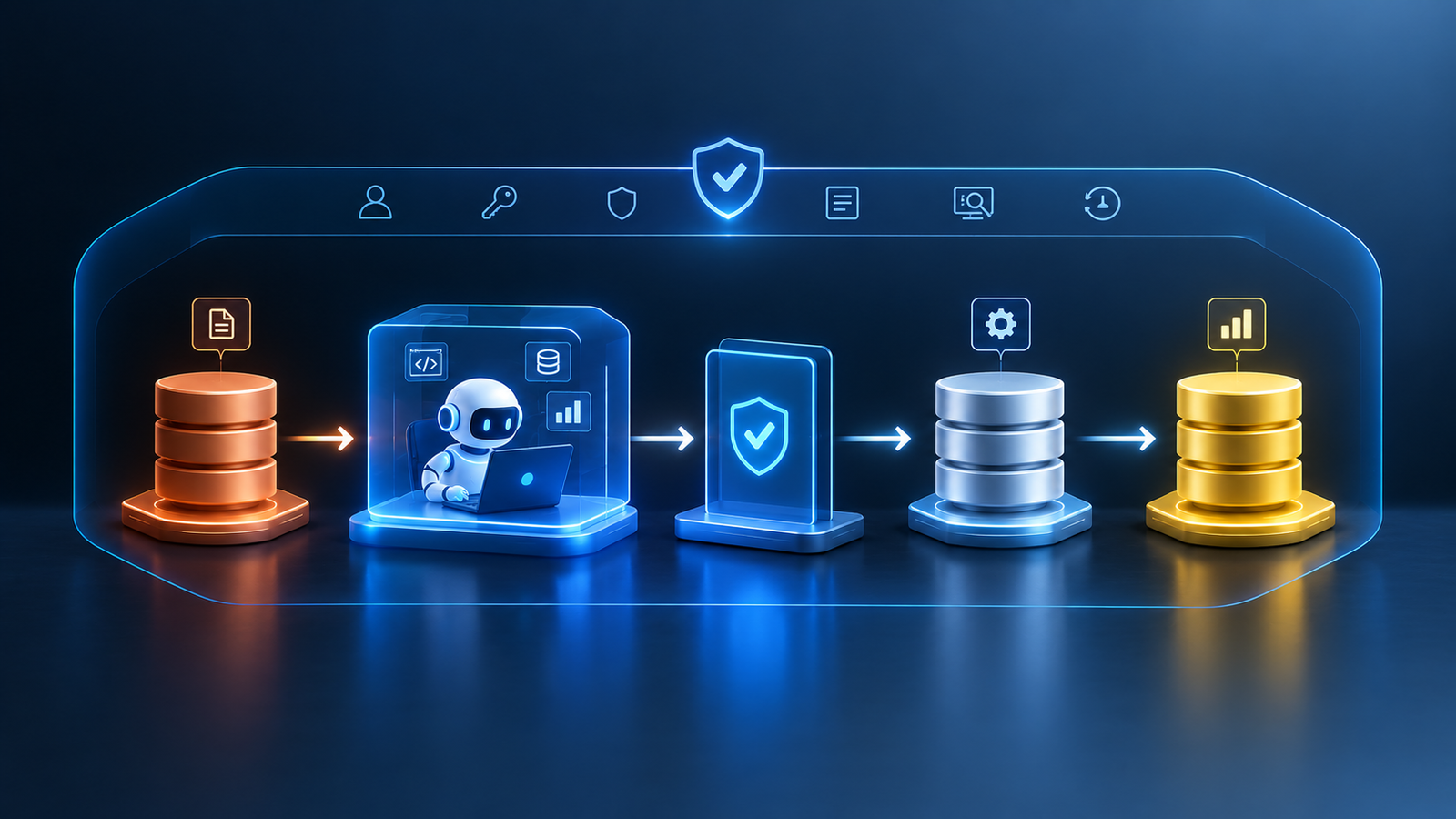
We need another layer around the pipeline: an authorization and control layer for agent actions.
View AI Data Pipeline Security Architecture
Why “Just Tell the Agent to Be Careful” Isn’t Enough
The first instinct is usually:
“We’ll give the agent instructions. We’ll tell it not to touch production.”
Instructions are useful.
They are not security boundaries.
An AI agent can misunderstand a task, select the wrong tool, follow malicious instructions hidden in retrieved content, or make an incorrect assumption about which environment it is operating in.
The more important question is therefore not:
“Will the agent behave?”
It’s:
“What happens if it doesn’t?”
That is where architecture beats prompt engineering.
Build a Locked Door, Not a Polite Sign
The safest approach is to make dangerous actions difficult or impossible by default.
1. Give Agents Read-Only Access by Default
An agent that only needs to analyze data shouldn’t have write access.
Use read-only replicas, views, semantic layers, or dedicated analytical environments wherever possible.
If the agent generates a destructive SQL statement but has no permission to execute it, the mistake stops at the database boundary.
That’s a real control, not a prompt asking the model to behave.
2. Replace Arbitrary SQL With Scoped Tools
“AI can query the database” is an extremely broad permission.
Instead, expose narrowly defined tools or APIs.
For example:
get_customer_metrics()validate_schema()run_quality_check()generate_model_diff()create_transformation_proposal()
The agent can perform useful work without receiving unrestricted database authority.
This is especially important as AI systems increasingly interact with external tools and services.
3. Propose, Don’t Execute
This may be the biggest architectural shift.
Instead of allowing an agent to directly modify production data, let it propose a change.
The workflow becomes:
Agent → Pull Request → Automated Tests → Policy Checks → Approval → Deployment
The agent can generate SQL, dbt models, migrations, or pipeline changes.
But execution happens only after validation and an explicit control point.
It’s essentially GitOps for data transformations.
The agent becomes a contributor, not the final authority.
4. Put a Sandbox Between Bronze and Gold
Give agents a controlled environment where they can experiment.
A typical flow could look like:
Source → Bronze → Agent Sandbox → Validation → Silver → Gold
Inside the sandbox, the agent can:
- Test transformations
- Explore schemas
- Generate models
- Run data-quality checks
- Detect anomalies
- Compare outputs
But promotion into trusted layers happens through controlled gates.
This gives the agent room to work without giving it the keys to the warehouse.
5. Enforce Least Privilege at Every Layer
Least privilege sounds obvious.
It becomes much more important when the “user” is an autonomous system.
Agent credentials should be:
- Environment-specific
- Time-limited
- Scoped to required tables or APIs
- Restricted by operation
- Revocable
- Auditable
A token discovered inside a repository should never automatically become a master key to production.
The PocketOS incident is a useful reminder of why credential scope and blast radius matter.
6. Make Rollback a Design Requirement
Prevention is important.
Recovery is equally important.
Use technologies and practices that make data changes reversible where appropriate, including snapshots, versioned tables, immutable storage, and transaction history.
Platforms built around formats such as Apache Iceberg or Delta Lake can provide capabilities such as snapshots and time travel that support recovery workflows.
But there’s an important caveat:
A backup is only useful if the same incident cannot destroy the backup too.
Keep critical backups outside the same permission and failure boundary as production.
7. Log the Agent’s Actions, Not Just the Result
Traditional pipeline monitoring asks:
“Did the job succeed?”
Agentic systems require more context:
- What did the agent attempt?
- Which tools did it call?
- Which credentials were used?
- What data did it access?
- What changes did it propose?
- Which policies allowed or blocked the action?
- Who or what approved execution?
This creates an audit trail for both the outcome and the decision path.
Agent Security Is Becoming an Architecture Problem
This isn’t just a theoretical concern.
OWASP’s Top 10 for Agentic Applications 2026 was developed as a security framework specifically for systems where AI agents can plan, act, and make decisions across workflows. The project says the framework was developed with input from more than 100 industry experts, researchers, and practitioners.
That shift is significant.
The conversation is moving beyond:
“How do we make AI generate better answers?”
toward:
“How do we control what an autonomous system is allowed to do?”
For data engineering teams, that means agent security cannot live entirely inside the prompt.
It belongs in IAM, database permissions, CI/CD, data contracts, network boundaries, observability, approval workflows, and disaster recovery.
The New Data Pipeline
The traditional architecture looked like:
Bronze → Silver → Gold
The agent-ready version needs another dimension:
Bronze → Controlled Agent Sandbox → Validation → Silver → Gold
with a security layer surrounding the entire workflow:
Identity + Permissions + Policy + Audit + Approval + Rollback
That’s the real evolution.
We’re not replacing the medallion architecture.
We’re adding control around it.
The Bottom Line
Bronze, Silver, and Gold answer an important question:
“How do we transform raw data into trustworthy business data?”
AI agents introduce another:
“How do we let autonomous systems work with that data without giving them unlimited power over it?”
The answer isn’t another system prompt saying “please be careful.”
It’s architecture.
Give agents the minimum access they need. Let them experiment in sandboxes. Replace unrestricted SQL with scoped tools. Make them propose changes before executing them. Validate everything automatically. Keep backups outside the blast radius. Log every important action.
Because the goal isn’t to build an AI agent that never makes a mistake.
That’s unrealistic.
The goal is to build a data platform where an agent’s mistake doesn’t become a catastrophe.
The future of data engineering isn’t just Bronze, Silver, and Gold.
It’s Bronze, Silver, Gold – and a locked door.
Frequently Asked Questions
1. Should AI agents ever have direct write access to production data?
In most cases, no, not by default. Agents should receive the minimum permissions required for their task, with read-only access preferred whenever possible. If a production change is genuinely required, use scoped permissions, automated validation, approval gates, and strong audit controls rather than giving the agent unrestricted write access.
2. What is the safest way to let an AI agent modify a data pipeline?
The safest pattern is to let the agent propose changes rather than execute them directly. The agent can generate SQL, dbt models, configuration changes, or pipeline code and submit them through a controlled workflow such as:
Agent → Pull Request → Tests → Security & Policy Checks → Approval → Deployment
This keeps the agent productive while ensuring that a separate control process decides whether the change reaches production.
3. How can data teams limit the damage if an AI agent makes a mistake?
Use defense in depth. Combine least privilege IAM, isolated sandboxes, scoped tools, environment specific credentials, network restrictions, approval gates, comprehensive audit logs, and independent backups. Most importantly, backups should not share the same credentials or permission boundary as the production environment. The goal is to reduce the agent’s blast radius when something goes wrong.
4. How does Clearleaff help secure AI data pipelines?
Clearleaff helps teams put control and governance around AI-driven data workflows. Instead of giving agents unrestricted access, Clearleaff can help enforce controlled permissions, policy checks, approvals, and auditability around sensitive data and actions.
This gives AI agents the freedom to work while keeping critical systems protected.
The goal is simple: let AI move fast, while keeping the right doors locked.