
Your supply chain answers questions once a day. Your customers ask them every second.
That gap is not a technology inconvenience. It is one of the largest uncaptured margin pools in retail. IHL Group’s 2025 study puts global inventory distortion at $1.77 trillion, with out-of-stocks accounting for roughly $1.2 trillion of it. The single largest contributor is not theft and not forecasting error. It is supply chain disruption, at $301 billion.
Most boards have already funded the response to this. They bought better forecasting, bought visibility dashboards, bought planning suites that promised a single version of the truth. And the number has not moved.
It has not moved because the problem was never that we could not see the disruption. It was that seeing it and being able to act on it are separated by a layer of infrastructure that operates on a schedule rather than on events.
The cost of an infrastructure that answers on a schedule
Roughly a fifth of US business-to-business transactions still run over EDI, according to Forrester, and that share is projected to be almost exactly the same in 2027. This is not a legacy technology quietly dying. It is load-bearing, and it will still be load-bearing at the end of this decade.
EDI does what it was designed to do extremely well. What it was designed to do, in the 1970s, was move a structured document from one company to another reliably. It was not designed to hold a conversation.
The consequence shows up everywhere in your P&L, usually under other names.
It shows up as the six to twelve weeks it typically takes to onboard a single new trading partner, which means your supplier diversification strategy moves at the speed of an integration backlog.In chargebacks, where vendors who do not actively manage compliance can see deductions running into low single-digit percentages of gross revenue, and where a manufacturer’s disputes with a single large retailer can consume a full-time team. In quarterly contract that was negotiated against a demand picture that stopped being true in week three.
And it shows up most expensively during exactly the events you most need to respond to. When Red Sea transits fell by roughly ninety percent between December 2023 and March 2024, the information that lanes had changed was available almost immediately. The ability to renegotiate volumes, windows and allocations across a few hundred suppliers was not. J.P. Morgan estimated the disruption alone could add 0.7 percentage points to global core goods inflation in the first half of 2024.
The disruption was not a surprise. The response was slow because responding required humans to individually rework commitments that the infrastructure could only express as static documents.
Why the answer is not more integration
The instinct is to buy another integration layer. I would push back on that, and so would most of the CIOs I talk to, because they have already bought three.
Every major supply chain vendor now ships AI agents. SAP has been rolling out Joule agents across procurement and supply chain. Blue Yonder, Kinaxis and o9 all launched agentic capabilities through 2025 and 2026. These are real products and some of them are genuinely good.
They also share a limitation that matters enormously at board level: they make your side of the conversation faster. Your agent can now analyse a demand spike in seconds. It still has to wait for a human at your supplier to read an email.
This is the part the category is not being honest about. An agent that is twice as smart on one side of a transaction does not halve the cycle time of the transaction. The bottleneck moves to the counterparty. And your counterparty will not solve it for you, because they have no intention of giving you direct access to their cost structure, their capacity constraints or their other customers’ allocations.
That refusal is not obstruction. It is entirely rational, and any architecture that requires suppliers to surrender it will fail for the same reason every previous attempt failed.
The thing that actually has to change
The unlock is not shared data. It is shared grammar.
Two organisations do not need to see inside each other to transact. They need a common, machine-readable way to express an offer, a constraint, a commitment and a settlement — so that software on both sides can negotiate within boundaries its owners set, without either party exposing anything underneath.
Concretely, this means a supplier’s system can answer “can you deliver 40,000 units to these four DCs by Thursday, and at what price” without revealing why the answer is what it is. Your buyer agent gets a commitment. It does not get their margin structure. Both sides keep their leverage, and the exchange that used to take four days takes four minutes.
This is a different proposition from data sharing, and CXOs should insist on the distinction. The value is created by removing latency from commitment, not by removing confidentiality.
Why this is not another five-year vision
Retail leaders are right to be sceptical here. This category has a graveyard. check, why networks owned by a participant fail
TradeLens, the Maersk and IBM shipping network, reached roughly sixty percent of global containerised trade and still shut down in early 2023. Collaborative planning initiatives before it delivered good pilots and poor adoption. Gartner now projects that more than forty percent of agentic AI projects will be cancelled by the end of 2027 on cost, unclear value or inadequate risk controls.
The instructive detail about TradeLens is that it did not fail on technology. It failed on governance. Competitors would not build their trade on infrastructure owned by Maersk. The lesson is not that open networks do not work. It is that networks owned by a participant do not work.
Which is why the most important development in this space is one most retail executives have not heard of.
India’s Open Network for Digital Commerce runs on the Beckn Protocol, an open decentralised standard for discovery, contracting and fulfilment. It is not a platform and not an intermediary. It is a set of open specifications that independently operated applications use to transact with each other. As of 2026 it has facilitated over 350 million transactions, with more than three hundred thousand sellers, over a hundred buyer applications and operations across four hundred-plus cities.
That is an open, multi-party, cross-organisational transaction network operating at national scale, owned by nobody, today.
The retail supply chain application of this substrate is new, and I would not claim otherwise. But the question a CXO should be asking has changed. It is no longer “can open agent-to-agent networks work at scale,” because that has been answered in production. It is “how quickly does this pattern reach my category, and do I want to be setting the terms or accepting them.”
The three questions to ask before funding anything
If you take one thing from this piece into your next steering committee, make it these.
Where exactly does the human stay in the loop, and is that boundary enforceable? Most implementations put spend limits and approval thresholds in application code, which means they can drift between services, be bypassed under deadline pressure, and cannot be independently audited. The stronger architecture enforces them at the protocol boundary, so that an agent’s authority is a scoped, time-limited, revocable credential rather than a configuration setting. Under the EU AI Act, oversight obligations scale with system autonomy, and penalties reach seven percent of global turnover. This is not a technical preference. It is a directors’ liability question.
Have your lawyers looked at this before your engineers finish it? If your buying agents and your suppliers’ selling agents negotiate price, you are in territory the antitrust agencies have already entered. The Department of Justice brought its first algorithmic collusion case against RealPage in 2024 and filed a proposed settlement in late 2025 that included a court-appointed monitor and restrictions on the use of non-public competitive data. Autonomous price negotiation is achievable. Autonomous price negotiation designed without counsel in the room is a different kind of achievement.
What happens to all of this when it is wrong? Agents will make errors, and in a cross-organisational setting an error becomes a commitment to a third party. The architecture has to answer reversibility, dispute resolution and non-repudiation before it answers efficiency. If a vendor cannot explain how a bad agent decision gets unwound, they have built a demo.
What this is worth, stated conservatively
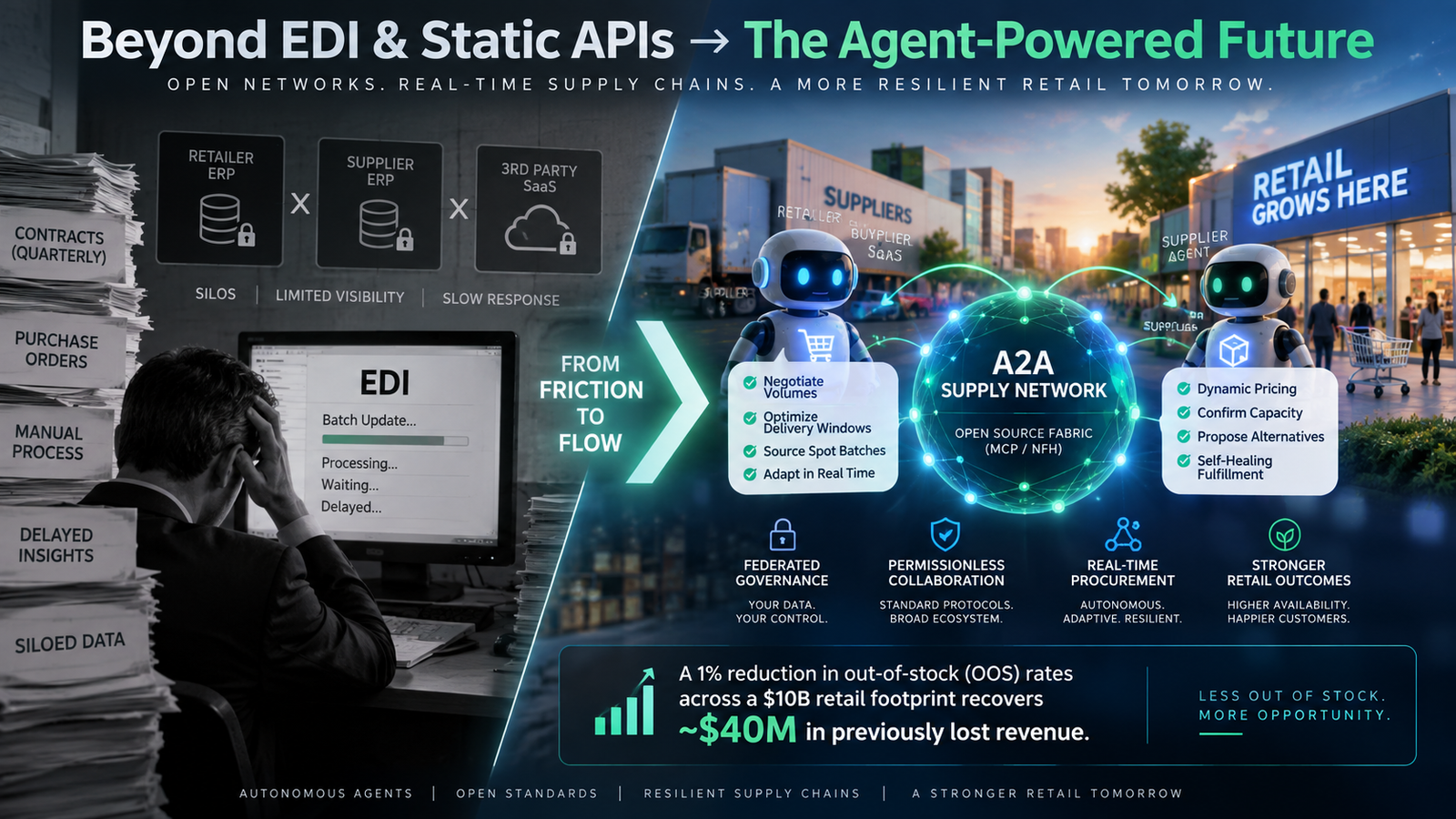
For a ten billion dollar retail business, improving on-shelf availability by a single percentage point recovers roughly forty million dollars in sales. That assumes a sales lift of about 0.4 percent per point of availability, which sits below most published estimates, so treat it as a floor rather than a forecast. The durable value is the gross margin on those units and the customers who did not learn to shop somewhere else, and some portion is offset by substitution. Read – How perishable markdown decisions erode margin
But notice what that figure represents. It is one point. On availability alone. It excludes the working capital released by shorter commitment cycles, the chargebacks avoided, the buyers no longer reconciling exceptions by hand, and the supplier relationships that stop being adversarial because the negotiation stopped being annual.
The realistic path is not replacement. EDI will still be settling your orders in 2030, and that is fine. The agents sit above it, sensing, proposing and negotiating within bounded authority, while the existing rails do what they have always done reliably. Anyone selling you a rip-and-replace is selling you a five-year programme that will be cancelled in year two.
Start where you control both sides of the transaction. Prove the governance model on your own internal decisions, where a mistake is a lesson rather than a lawsuit. Get your product identity discipline in order, because agents cannot negotiate over items they cannot unambiguously name. Then extend outward to suppliers who are ready, on open protocols rather than a vendor’s private network.
The companies that move first will not win because their agents are smarter. They will win because they will be the ones who wrote the rules everyone else has to trade under.
FAQ
What is an agent-to-agent supply network? An arrangement in which autonomous software agents representing different companies negotiate terms such as volume, price and delivery windows directly with each other, using a shared open protocol, without either company exposing its internal systems or cost data.
Does this replace EDI? No. EDI remains the settlement and system-of-record layer. Agents operate above it, handling sensing, proposal and negotiation, then committing through existing rails.
What is the business case? For a $10 billion retailer, a one-point improvement in on-shelf availability is worth roughly $40 million in recovered sales, before accounting for working capital release, chargeback reduction and procurement labour.
What is the main risk? Two. Autonomous price negotiation between buyer and supplier agents carries real antitrust exposure, as the RealPage enforcement action demonstrated. And under the EU AI Act, human oversight obligations increase with system autonomy, with penalties reaching seven percent of global turnover.
Is this proven anywhere? The underlying pattern is. India’s ONDC network, built on the open Beckn Protocol, has processed over 350 million transactions across more than 400 cities as an open multi-party network owned by no single participant. The retail supply chain application of that substrate is new.